
Insights — Franchising & Business Growth
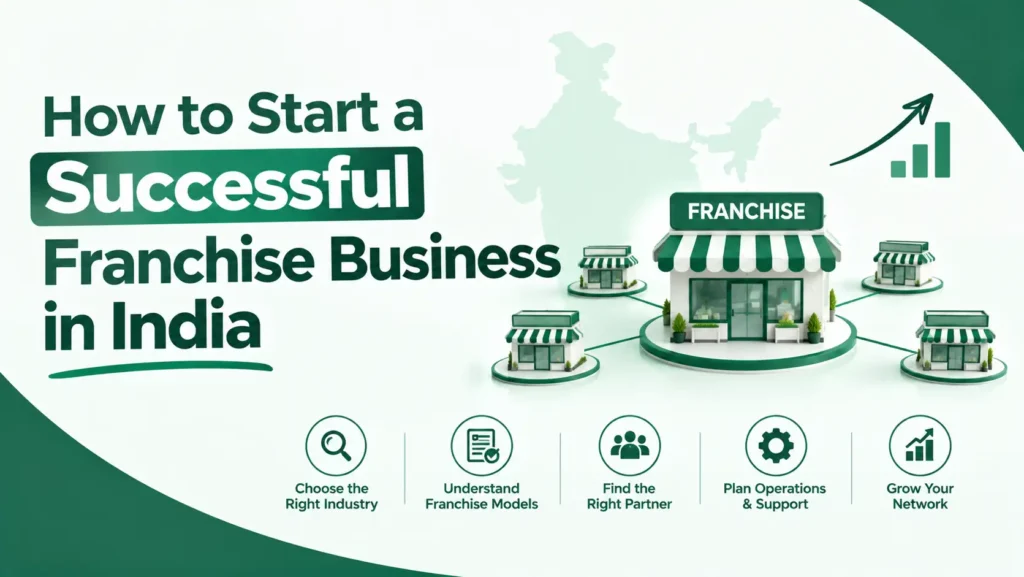
How to Start a Successful Franchise Business in India
A 2026 guide for investors and founders in Delhi NCR, Mumbai, Bengaluru and India's top cities
By Saurabh Mishra · Published on KKJ Advisory · Updated October 2026 · 9 min read
A franchise doesn't remove business risk. It swaps some of it for a different set: you borrow a brand and a system, and you take on fees, rules and a contract you can't easily leave.
That trade works well for people who go in clear-eyed, and badly for people who buy a brand on the strength of a brochure. India's franchise market is large and still growing, but there is no franchise law, no mandatory disclosure document and no regulator checking a franchisor's claims. The due diligence is yours to do.
This guide walks through how to do it, whether you want to buy a franchise or franchise your own business. It includes what to check, what to model and how the picture changes between Delhi NCR, Mumbai and Bengaluru.
The Indian Franchise Market at a Glance
Before choosing a brand or a city, it helps to know what the market actually looks like. Figures below are from the FranCast franchise forecast (2023–24) and NRAI projections, so treat them as directional.
| Indicator | What the Data Shows |
|---|---|
| Active franchisors | About 4,600, running nearly 2 lakh outlets |
| Share of franchise concepts in food & beverage | Around 35% |
| Franchisees starting at ₹5–10 lakh | About 40% of franchisees |
| Franchisees running multiple units | About 53% |
| Food services market (NRAI projection) | ₹5.69 lakh crore in FY24 to about ₹7.77 lakh crore by FY28 |
"The franchise fee is the cheapest part of the decision. The expensive mistakes are the wrong location, the wrong contract and not enough cash to survive the first six months."
— Saurabh Mishra, KKJ Advisory
Decide Which Side of the Franchise You're On
"Starting a franchise business" means two very different things, and the playbooks barely overlap.
- Franchisee: you buy the right to run an outlet under an existing brand. Your job is to choose well, fund it properly and operate it consistently.
- Franchisor: you turn your own business into a repeatable model that others fund and run. Your job is to prove the model, document it and support it. See the franchisor section below.
Why it matters: Most of the advice online blurs the two. Decide first, because the questions you need to ask are different.
Match the Sector to Your Capital, Skills and Time
Food and beverage is the most visible franchise category, but it isn't the only one. Education, retail, healthcare, wellness, laundry and services all run franchise models, and each has a different cost base and skill requirement.
Three questions to settle first
- How much capital can you commit, and how much can you afford to lose?
- Will you run the outlet yourself, or do you need a manager or a company-managed format?
- Do you have any real experience in the category, or are you buying a brand name?
Some brands offer franchise-owned, company-managed (FOCM) formats where the brand runs daily operations and you fund the outlet. That can suit investors with capital but little time, though you give up control and should read the economics closely. If you are still choosing between ideas, our startup and SME advisory work starts with exactly this kind of fit question.
Vet the Franchisor Like You'd Vet an Acquisition
In India a franchisor isn't legally required to hand you a standard disclosure document. That makes your own checks the only real protection.
What to verify before you sign anything
- How many outlets are actually operating, versus how many franchises were sold.
- How many outlets have closed in the last two to three years, and why.
- Unit-level profit and loss data from existing franchisees, not a projected ROI slide.
- Conversations with several current franchisees, including ones the brand didn't introduce you to.
- Whether the trademark is registered and in the franchisor's name. You can check this on the public Trade Marks registry.
- What training, supply chain and marketing support is promised, and where it is written in the agreement.
Rule of thumb: If a brand won't let you speak to its struggling franchisees, you have learned what you needed to know.
Model the Full Investment, Not Just the Franchise Fee
The headline fee is rarely the real cost of getting to a trading outlet. Build the full picture before you commit.
Costs to include
- Franchise fee, plus 18% GST on the fee and on royalties. You can usually claim input tax credit, subject to normal eligibility rules.
- Security deposit, rent and fit-out for the location.
- Equipment, initial inventory and licences.
- Pre-opening marketing and staff training.
- Ongoing royalty and marketing-fund contributions.
- Working capital to cover the months before the outlet breaks even.
Build three scenarios: a base case, a slow ramp-up case and a rent-or-cost shock case. If the outlet only works in the optimistic scenario, it doesn't work. Be sceptical of any payback period that doesn't state its assumptions. This is the same discipline we apply in profitability improvement engagements: know your margin after every fee before you scale.
Get the Legal Foundation Right
India has no dedicated franchise statute. Franchise relationships are governed by the Indian Contract Act, 1872, along with the Trade Marks Act, 1999, the Competition Act, 2002, GST law and, where foreign brands are involved, FEMA. In practice, the franchise agreement does the work a franchise law would do elsewhere.
Registrations to line up
- A business entity. Many franchisors require a Private Limited company or LLP, so check the brand's terms.
- GST registration, Shops and Establishment registration and a local trade licence.
- FSSAI licence for any food or beverage outlet.
- Sector-specific approvals such as fire safety and pollution control, where they apply.
Clauses worth negotiating
- Territory and exclusivity: what stops the brand opening another outlet near you?
- Term, renewal conditions and what happens at expiry.
- Royalty basis, marketing-fund use and any increases.
- Termination rights, exit terms and transfer of the outlet.
- Non-compete restrictions after exit, which can be hard to enforce and deserve specific legal advice.
Have a lawyer who knows franchise contracts review the agreement before you sign. This section is general information, not legal advice.
Choose Your City and Catchment Deliberately
The same brand can thrive in one catchment and struggle in another three kilometres away. City choice is a pricing, footfall and competition decision, not just a prestige one.
Delhi NCR, Mumbai and Bengaluru behave differently in cost, customer mix and competition. We break each one down in the city-by-city section below. For a data-led view of demand in your specific micro-market, market research and competitor analysis is far cheaper than a failed outlet.
Plan Funding and the First 12 Months
Most franchise failures are cash failures. The outlet may be fundamentally sound but run out of money before it matures.
- Fund the investment from a mix of your own capital and, if needed, bank or NBFC borrowing that you can service even in a slow quarter.
- Hold a cash reserve for the ramp-up period, separate from the setup budget.
- Agree who pays what, and when, before opening: fit-out, deposits, staff salaries and royalties.
- Set a review point at three, six and twelve months with clear numbers you are tracking.
Why it matters: Under-funding working capital is the single most avoidable reason a good franchise fails. If you want a second opinion on the model, our fractional CXO services can provide senior finance and operations judgment without a full-time hire.
Launch Locally, Then Run It as a System
The brand brings recognition, but local demand still has to be built outlet by outlet, and most franchisors only supply national marketing.
Local visibility checklist
- A fully completed Google Business Profile with correct hours, photos and category, and a plan to collect genuine reviews.
- Local search presence for your area and nearby localities, for example "franchise outlet in Indiranagar" or "near Sector 18 Noida".
- Listings on delivery and booking platforms where your category depends on them.
- Hyperlocal paid campaigns in the first 60 days, then a lower steady spend.
Our digital marketing services cover local SEO, performance marketing and visibility in AI-generated answers for exactly this kind of location-led business.
Then make operations repeatable
- Write down daily SOPs for opening, service, stock and cash handling.
- Train staff to the brand standard and track the metrics the franchisor audits.
- Stay close to supply: stock-outs and delays erode a franchise outlet's reputation fast. See our operations management and supply chain consulting work for how we approach this.
Franchise Business in Delhi NCR, Mumbai and Bengaluru
The three largest franchise markets in India each reward a different approach. One 2026 report on India's burger QSR chains, by Kennis Ventures, shows how the store bases compare: Delhi NCR 364 stores, Mumbai Metropolitan Region 288 and Bengaluru 181. Bengaluru and Pune were growing fastest, at 53.4% and 56.3% since 2023. It covers one segment only, but it illustrates the pattern.
Scale and variety. The largest urban hub, with a broad customer mix and strong demand across food, education, retail and services.
Watch for: "Delhi" is really several markets. Gurugram, Noida, Ghaziabad, Faridabad and Delhi itself differ in income, footfall and competition, and licensing rules differ between Delhi, Haryana and Uttar Pradesh. Pick the catchment first, then the site.
Premium demand, tight space. High spending power and strong appetite for food, cafés and lifestyle brands.
Watch for: Space is scarce and expensive, so compact formats, kiosks, shop-in-shop and delivery-led models often make more sense than large outlets. Mumbai, Thane and Navi Mumbai are distinct catchments with different rent and footfall.
Fast growth, tech-driven demand. A large working-age, tech-sector population with strong café, health, fitness and delivery habits.
Watch for: Micro-markets such as Koramangala, Indiranagar, HSR Layout, Whitefield and Electronic City behave like separate cities. Traffic shapes delivery radius and footfall, so test commute patterns before choosing a site.
Other cities worth a look
| City | Signal | Consider it if |
|---|---|---|
| Pune | 100 burger-QSR stores, about 56% growth since 2023 | You want a fast-growing market near Mumbai's customer profile |
| Hyderabad | 74 stores, about 32% growth since 2023 | You prefer a smaller, still-expanding base |
| Jaipur, Lucknow, Indore, Ahmedabad | Brands expanding beyond metros, per a 2026 Grant Thornton Bharat study for NRAI | You want lower entry costs and are ready to localise the offer |
Tier-2 cities aren't automatically better. Costs are lower, but customer habits and spending also differ, so a format that works in Bengaluru may need adjusting in Jaipur.
If You Want to Franchise Your Own Business
Franchising is a growth strategy, not a funding trick. It only works if franchisees can make money after paying you.
A repeatable model with healthy unit economics, ideally across more than one company-owned outlet, before you sell a single franchise.
Written SOPs, training material, supplier terms and a registered trademark. A founder's instinct can't be franchised, but a system can.
Franchisee selection, training, supply, marketing and audits. Your fees only hold up if your franchisees' outlets do.
Designing the model sits at the intersection of business strategy, go-to-market planning and sales management, because recruiting franchisees is itself a sales process.
Three Mistakes That Sink Franchise Owners
Most failed franchises trace back to one of these.
A strong brand in a weak catchment still fails. Location, rent and footfall decide more outcomes than the logo does.
Brochure returns are sales material. Ask for actual unit-level results from outlets of similar age, size and city.
Outlets rarely hit projections in month one. Without a cash reserve, a sound business can fail before it matures.
Frequently Asked Questions
It varies widely by sector and format. The FranCast franchise forecast found that about 40% of franchisees start with an initial investment of ₹5–10 lakh, while some food formats run from around ₹1 crore to ₹4 crore. Add 18% GST on the franchise fee and royalties, plus working capital for the ramp-up period.
There is no single best city. Delhi NCR has the largest and most varied customer base, Mumbai offers premium demand but costly space, and Bengaluru is growing quickly with a tech-driven customer base. Tier-2 cities offer lower entry costs. The right choice depends on your format, budget and the specific catchment.
No. India has no dedicated franchise statute and no mandatory franchise disclosure document. Franchise agreements are governed by the Indian Contract Act, 1872, along with trademark, competition, tax and sector laws, which makes the agreement itself the most important document.
No honest answer applies to every investor. Food and beverage is the largest category by number of concepts, but it is also highly competitive. Profit depends on the unit economics of the specific brand, your location, your costs and how well the outlet is run. Ask for real outlet-level results rather than category averages.
Many franchisors require a registered entity such as a Private Limited company or LLP, so check the brand's terms. Whatever the structure, you will typically need GST registration, a Shops and Establishment registration, a local trade licence and, for food outlets, an FSSAI licence.
Lower-investment formats exist, including kiosks, shop-in-shop outlets, service-based and delivery-led models. Metro rent is the main constraint, so many investors look at secondary micro-markets, smaller formats or Tier-2 cities. Whatever the budget, keep a cash reserve for the first months.
It depends on the sector, rent, ramp-up speed and how well the outlet is run. Treat any payback period quoted without its assumptions with caution, and ask existing franchisees of similar age and size how long it actually took them.
It reduces some risks, such as brand awareness and operating systems, but not all of them. You still carry rent, staff and working capital, and results vary a great deal with the quality of the franchisor. A good franchise lowers the risk of building a model from scratch, but it does not remove the risk of running an outlet.
We help investors pressure-test a franchise before committing, through market research, unit-economics modelling and city-level demand analysis. We also help founders design a franchise model for their own brand. Start with a conversation through our contact page.
Planning a Franchise in Delhi, Mumbai or Bengaluru?
Whether you are evaluating a brand or building one, KKJ Advisory helps you check the numbers, the city and the contract before you commit capital. Learn more about us.
Book a Strategy CallData sources: FranCast Franchise Forecast 2023–24 (as reported by India Retailing); NRAI India Food Services Report projections (via Petpooja); Kennis Ventures QSR Watch, Edition II (via Media Infoline). Investment ranges and market figures change; verify current numbers with each franchisor. This article is general information, not legal or financial advice.