
Insights — Digital Marketing
6 Latest Digital Marketing Trends to Watch Out for in 2026
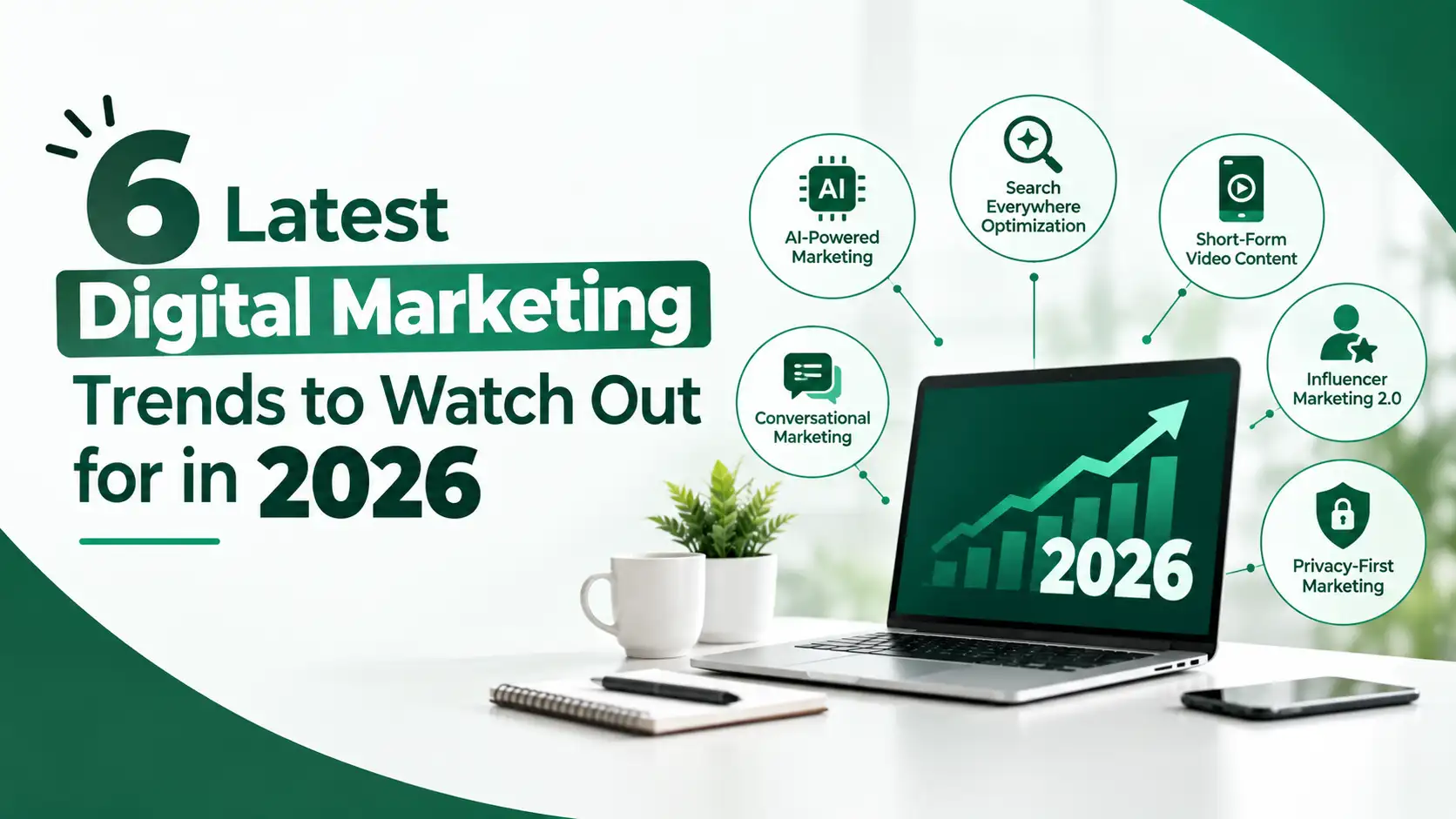
Digital marketing isn't evolving gradually anymore — it's being rebuilt around AI, shifting search behaviour, and tighter budgets, all at the same time.
Halfway through 2026, enough real data has come in to separate what's genuinely reshaping how brands reach customers from what was only ever a conference-slide trend. The shifts below aren't speculative — they're already showing up in budgets, click-through data, and how marketing teams are structured.
At KKJ Advisory, we track these shifts closely because they change what "good marketing execution" actually looks like from one year to the next. Here are the six trends worth building your 2026 strategy around.
2026 Digital Marketing, by the Numbers
A quick snapshot of the data behind this year's biggest shifts, before we get into what each one means for your strategy.
| Metric | What the Data Shows |
|---|---|
| Consumers favouring personalised content | 75% more likely to buy from brands that personalise |
| Marketers using AI for content creation | 80% report using it today |
| Google searches ending without a click | Roughly 68% of searches |
| Marketing budget as share of company revenue | Flat at around 7.8% |
"The brands winning in 2026 aren't the ones using the most AI tools. They're the ones who've figured out which three or four actually move revenue, and cut the rest."
— Saurabh Mishra, KKJ Advisory
AI-Powered Personalization Becomes the Default, Not a Differentiator
Personalization has moved from "nice to have" to expected. A large majority of consumers say they're more likely to buy from brands that deliver personalized content, and AI has made that kind of targeting achievable at a scale that was impractical even two years ago.
What to do about it: Use AI to segment audiences and tailor messaging across email, ads, and on-site content, but treat the tools as a layer on top of a clear customer strategy — not a replacement for one. Generic "AI personalization" that just inserts a first name isn't what's driving these numbers; relevance is.
Search Behaviour Keeps Migrating Into AI Engines
This is the trend with the clearest data behind it. A majority of Google searches now end without any click to a website, and click-through rates drop sharply whenever an AI Overview appears on the results page. Users are increasingly getting their answer without visiting a site at all.
What to do about it: Visibility inside AI-generated answers — what we cover in depth in our Generative Engine Optimization (GEO) guides — now needs its own budget line and its own content strategy, separate from (but connected to) traditional SEO.
Agentic AI Moves From Pilots to Real Marketing Operations
2025 was the year marketing teams experimented with AI. 2026 is the year it starts running parts of the operation directly — handling campaign optimization, customer engagement tasks, and reporting with less manual oversight. Industry forecasts expect a majority of companies to be using agentic AI in some form within the next couple of years.
What to do about it: The bottleneck isn't the technology — it's organisational readiness. Most teams that have adopted these tools still report they aren't fully set up to scale them. Building clear approval workflows and quality checks around agentic AI matters more right now than adding more tools to the stack.
Short-Form, Platform-Native Video Keeps Winning Attention
Audiences — especially digital-first generations — continue to spend their time scrolling short-form video on platforms like Instagram, YouTube, and TikTok. A large majority of marketers now use AI specifically to help produce this kind of media at the volume these platforms demand.
What to do about it: Prioritise content built natively for each platform's format and pacing over repurposed long-form clips. AI tools can help with volume and iteration speed, but the content still needs to feel made for the platform it's appearing on, not adapted to it.
Predictive Analytics Replaces Guesswork in Content Planning
Brands are increasingly using real-time data and machine learning to spot shifts in audience sentiment, demand, and keyword interest before competitors do, rather than reacting after a trend has already peaked. A meaningful share of marketers now say forecasting campaign performance before launch is a top priority for their AI investment.
What to do about it: Build a habit of reviewing search intent, engagement data, and social listening insights before greenlighting content — not just after it publishes. Insight-based planning is replacing the "post and see what sticks" approach across most well-run marketing teams.
Flat Budgets Are Forcing Martech Consolidation
Marketing budgets as a share of company revenue have stayed essentially flat, and the portion of that budget going to marketing technology has hit its lowest point in years. Teams juggling a dozen disconnected point-solutions are increasingly consolidating onto fewer, more integrated platforms.
What to do about it: Audit your current stack for overlapping tools before adding anything new. In a flat-budget environment, cutting two underused platforms usually creates more room to invest in AI or content than any new budget request will.
The Common Thread: Measurement Is Being Rebuilt
Every trend above points to the same underlying shift — success is being measured less by clicks and traffic volume, and more by visibility, influence, and the quality of who actually converts. Fewer visitors, arriving later in their research and converting at higher rates, is quickly becoming the new normal to plan around.
Frequently Asked Questions
AI-powered personalization and predictive, insight-based content planning tend to offer the fastest, most affordable wins for smaller teams, since they mostly require better use of data you likely already have, rather than a large new technology investment.
No — it's becoming a foundation rather than the finish line. AI-generated answers are still built largely from well-ranked, well-structured web content, so strong SEO fundamentals remain necessary even as visibility inside AI answers becomes an additional goal.
It's shifting roles more than eliminating them. Teams are moving away from manual execution and toward supervising, directing, and quality-checking AI-driven workflows, which still requires marketing judgment — just applied differently than before.
Rather than treating it purely as a loss, shift part of your measurement framework toward visibility and citation inside AI-generated answers, and toward the quality of the traffic you do get — since AI-referred visitors tend to arrive later in their research and convert at a noticeably higher rate.
No. Even small teams often accumulate overlapping subscriptions over time — separate tools for email, social scheduling, analytics, and AI content that could be handled by one integrated platform. A stack audit is worth doing at any company size.
Adopting AI tools and new formats without a clear strategy behind them. The data shows the biggest gap right now isn't access to technology — it's organisational readiness to use it well. Strategy and measurement discipline matter more than the number of tools in the stack.
Build a 2026-Ready Marketing Strategy
At KKJ Advisory, we help brands cut through the noise around AI and marketing trends, and build strategies grounded in what's actually moving revenue.
Book a Strategy Call