
Insights — SEO & AI Search
How to Rank on Google Search's AI Overview in 2026?
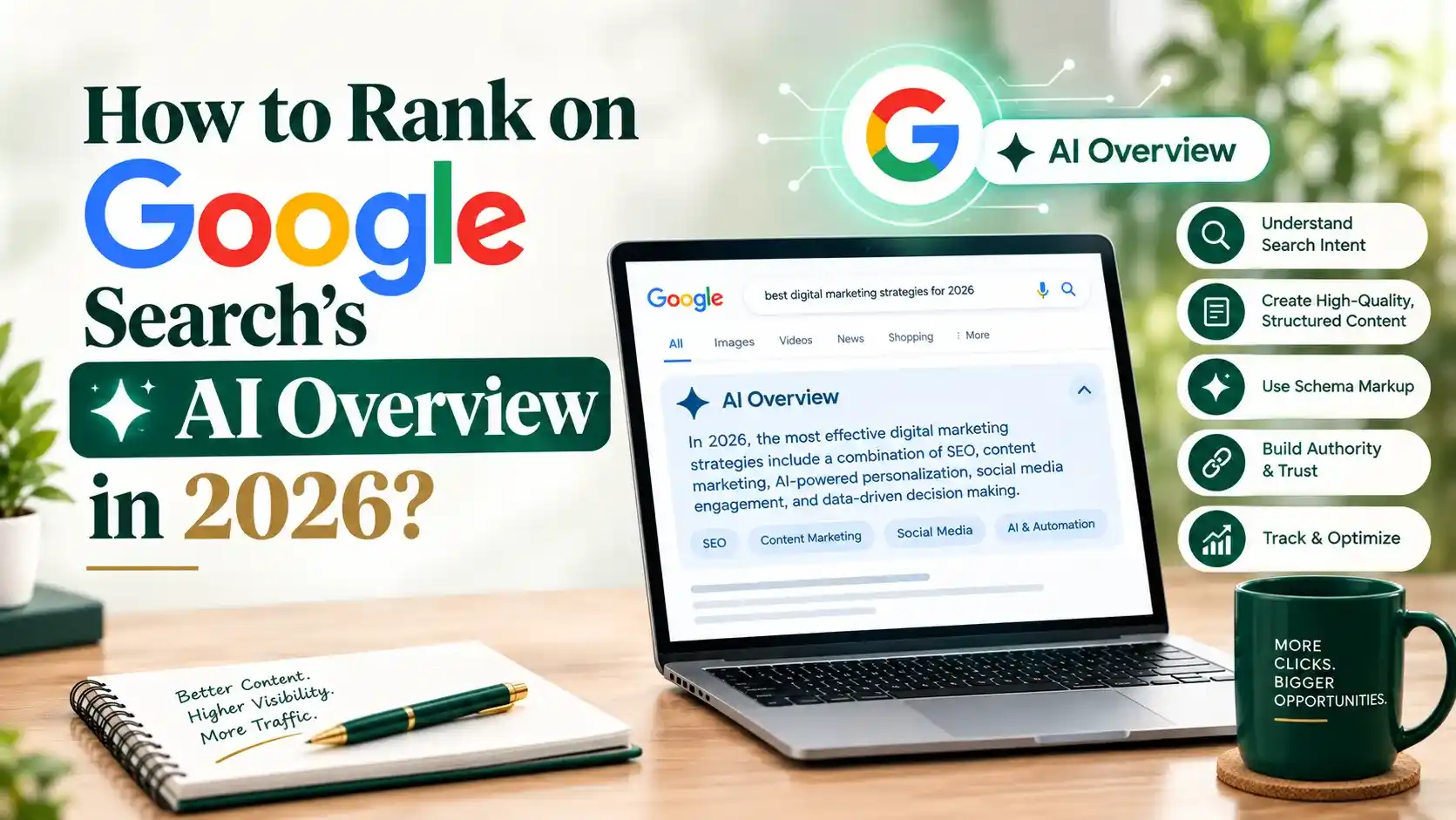
AI Overviews now sit above the organic results on a large share of Google searches — and appearing inside one has quietly become more valuable than holding the top organic spot underneath it.
The challenge is that Google has never published a formula for it. What we do have is a growing body of independent research, based on real citation data, that shows a consistent pattern in what gets pulled into the AI Overview and what gets left out. This guide breaks that pattern down into a practical playbook.
One thing worth setting straight first: ranking in an AI Overview is not the same game as ranking #1 organically. Studies analysing citation data have found that a large majority of pages cited inside AI Overviews are not the top organic result for that query — which means AI Overview visibility needs its own, deliberate strategy rather than being treated as a byproduct of good rankings.
Where AI Overviews Actually Show Up
Before optimising for AI Overviews, it helps to know which searches trigger them in the first place. Citation research consistently points to informational, question-shaped queries.
| Query Type | Approx. AI Overview Trigger Rate |
|---|---|
| All Google searches (average) | Roughly 1 in 5 searches |
| Question-based queries | Just under 6 in 10 |
| "Why" queries | Just under 6 in 10 |
| Pages cited that aren't the #1 organic result | Roughly 7 in 10 citations |
Earn a Top-10 Organic Ranking First
This is the non-negotiable prerequisite that most guides bury too far down. Large-scale citation analyses show that the vast majority of pages cited in AI Overviews already rank inside the top 10 organic results for that query, with the median cited page sitting around position two or three.
Why it matters: AI Overviews are built from the same web index that powers regular search — there's no separate "AI crawler" ranking pages differently. If a page can't earn a top-10 organic spot on its own merit, it has almost no realistic path into the AI-generated answer above it.
Answer the Question in the First Few Sentences
AI Overviews are built to extract, not to interpret. Content written in the traditional blog style — a long, scene-setting introduction before the actual answer — works against you here.
How to structure it
- Open each section with a direct, self-contained answer in the first two to three sentences.
- Follow an inverted-pyramid structure: answer first, context and nuance after.
- Keep each answer passage roughly 130–200 words so it can be lifted cleanly into a summary.
Why it matters: The model is scanning for a passage it can quote or paraphrase with minimal editing. A clear, standalone answer near the top of a section is far easier to extract than the same answer buried in paragraph four.
Optimise for Factual Density, Not Word Count
One of the more counter-intuitive findings from recent citation research: there's almost no correlation between how long a page is and how often it gets cited. What correlates far more strongly is factual density — how many specific, checkable claims a passage packs in.
Why it matters: Padding a page to hit a word-count target does nothing for AI Overview visibility. A tight, fact-dense 600-word page will often out-cite a rambling 3,000-word one, because the model has more to work with per sentence.
Build Real E-E-A-T Signals Into the Page
Google has been explicit that Experience, Expertise, Authoritativeness, and Trustworthiness matter for AI-powered search surfaces, not just traditional rankings.
Practical ways to strengthen this
- Add a visible author bio with relevant credentials or experience.
- Cite original data, case studies, or first-hand examples instead of only referencing other articles.
- Keep publish and "last updated" dates current, especially on pages covering fast-changing topics.
Why it matters: When multiple pages say roughly the same thing, the one that visibly demonstrates real expertise and firsthand experience is the one more likely to be trusted as a source.
Use Question-Based Headings
Structure your H2s and H3s the way a user would actually phrase the question, rather than as generic topic labels.
- Prefer "How does X work?" over a vague heading like "Overview."
- Match heading phrasing to the way people search, including common variations of the same question.
- Keep one clear question — and one clear answer — per section, rather than blending several ideas under one heading.
Why it matters: Question-shaped headings make it easier for the model to map a user's query directly to the section most likely to contain the answer.
Don't Neglect the Technical Foundation
None of the content-level work matters if the page itself is slow, hard to crawl, or poorly structured for mobile.
- Fast load times and strong Core Web Vitals.
- Clean crawlability and indexability, with no accidental blocks on Google's crawlers.
- A mobile-friendly layout, given how much Indian search traffic is mobile-first.
Why it matters: Technical SEO is the foundation both traditional rankings and AI Overview citation are built on. Without it, even excellent content produces inconsistent, unreliable results.
Know What AI Overviews Are Actually Optimising For
On many commercial and shopping-adjacent queries, research has found AI Overviews trigger constantly but rarely name a specific brand by name. The engine tends to behave less like a recommendation surface and more like a category-explainer — synthesising what the category is and how it works, rather than picking a winner.
Why it matters: For competitive or commercial topics, the realistic goal often isn't "get my brand named" — it's owning the category-defining explanation that the AI Overview ends up paraphrasing, with your brand positioned as the source underneath it.
The Quick-Reference Checklist
If you only act on one thing from this guide, work through these in order — each step builds on the one before it.
Confirm the page already ranks in the top 10 organically, and that Core Web Vitals, crawlability, and mobile experience are solid.
Rewrite key sections with a direct answer up top, question-based headings, and dense, specific facts over filler.
Add author credentials, original data or examples, and keep the page's information visibly current.
Frequently Asked Questions
No. Most pages cited inside AI Overviews aren't the #1 organic result — they're typically within the top 10, often around position two or three. What matters more than the exact rank is whether the content is structured to be directly extractable.
No, and this is one of the more surprising findings in recent research. Citation rates correlate far more strongly with factual density and clarity than with total word count. A tighter, fact-rich page often performs better than a long one padded with generic context.
The underlying content signals overlap significantly, but the ranking dynamics aren't identical. This guide focuses specifically on the AI Overview panel shown in standard search results; AI Mode is a related but separate surface that's still evolving as Google publishes more guidance.
Informational, question-based queries — particularly "how," "what," and "why" questions — trigger AI Overviews far more often than transactional or navigational searches. These are the highest-leverage targets for most content-driven optimisation efforts.
Yes, provided the specific page ranks in the top 10 for the target query and is structured with clear, direct, fact-dense answers. AI Overview citation depends more on how well a page answers a specific question than on overall domain size or age.
Not always, especially on commercial or shopping-related queries, where AI Overviews often explain the category rather than naming specific brands. On many informational queries, however, being the cited source — with a visible link — is achievable and valuable even without a brand name-check in the summary text itself.
Build a Content Strategy That Wins Both Rankings and Citations
At KKJ Advisory, we help brands structure their content and technical SEO so it performs in traditional search results and earns visibility inside AI-generated answers.
Book a Strategy Call